 When ST 2110 was published in 2017, it enabled workflow improvements by allowing audio channels to be separated into individual “flows”, usually multicast streams. This capability enables equipment to work on different audio flows, for example representing different languages—such as English and French—independently, so that equipment could only process the flows it needs. In contrast, with an SDI signal, equipment would have to receive the whole signal, including high bandwidth video, in order to process just one audio track, adding complexity operationally and in product design/cost.
Because of this, buyers of ST 2110-compatible products, such as our low-latency encoders and decoders, want to know how many “flows” can be processed. Yet product manufacturers are using arcane jargon that makes it very difficult to know. Many manufacturers are often (deliberately?) opaque about the capabilities of their devices, talking instead of the “number of channels” and of levels A, B, and C, which obscure actual capabilities (channels AND flows).
Following an earlier blog post that clarified MPEG-TS audio terminology, this blog post aims to clarify ST 2110 audio terminology.
Flows
In the context of ST 2110, a flow refers to an individual stream of audio that can be routed and processed separately from others, usually as a multicast stream. For example, in a broadcast requiring both English and French commentary, each language can be processed as a distinct flow.
It would, of course, be possible to send English and French together in a single flow, but this would lack flexibility as the audio could not be “broken out”, i.e. processed independently.
Key Points:
- Distinct Streams: Flows allow for independent audio processing, making it easier to manage multiple languages or audio tracks.
- Importance of Number of Flows: The number of individual flows is critical in a ST 2110 facility, but often is vague in product datasheets.
The diagram below shows how languages can be carried together as a single multicast flow, similar to how it was carried historically in SDI, vs the flows being available as individual multicasts flows.
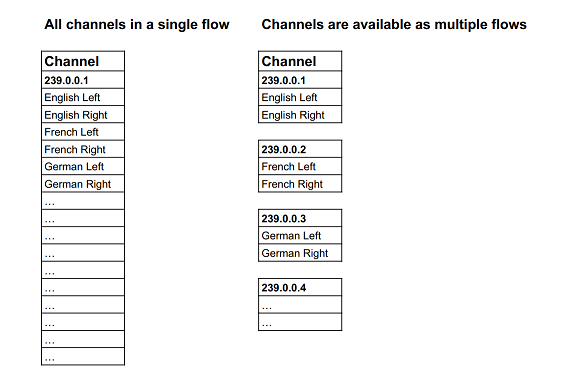 There are two schools of thought here. Some would argue that it’s important to maintain backwards compatibility with SDI and use a single flow. But others would argue the whole point of ST-2110 is to allow individual audio processing of flows.
Channels
A channel in ST 2110 refers to a single audio pathway that carries an audio signal. In stereo audio, there are typically two channels: left and right. Each channel carries its own audio signal, and usually these two channels work together to create a cohesive listening experience.
Most importantly, the number of channels and number of flows are two separate things. It is possible for a device to support multiple channels but only one flow. Likewise a device can support multiple channels and multiple flows at the same time. All of these combinations are possible.
Levels A, B, and C in AES67
The terms Levels A, B, and C in AES67 describe various configurations of channels in a given flow that an audio receiver can process. However, they can often introduce unnecessary complexity, obscuring the actual capabilities of audio systems.
For example, the table below refers only to only a single flow, BUT it talks in terms of channels.
Caution:
- Some manufacturers may use these terms to create the impression of greater capabilities than exist. For example, Levels A, B and C above only refer to a single flow but talk of multiple channels. This can hide the fact that a device, even though it supports multiple channels, might only support a single flow, which could lead to a potential “bait and switch” scenario where the implied capabilities don’t match actual performance. Care and attention is needed.
Conclusion
While ST 2110 promises greater flexibility and control, the audio industry’s reliance on sometimes arcane terminology can complicate real world implementation. By understanding these concepts—flows, channels, and levels—engineers are better equipped to make informed decisions about their audio equipment, ensuring their setups align with their facilities’ needs.
At Open Broadcast Systems, we have thoroughly tested various combinations of 2, 4, 8, and 16 channels per flow AND up to 8 flows. Here’s an example from our decoder.
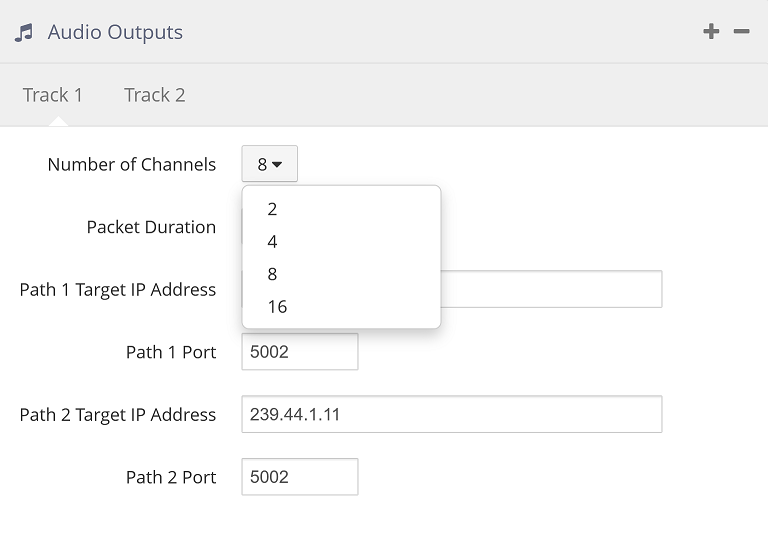 Our products support a vast array of configurations that meet most audio demands. And because they are software-based, it is always possible to add more – unlike hardware, we have no real limit. More on that in another blog post.