
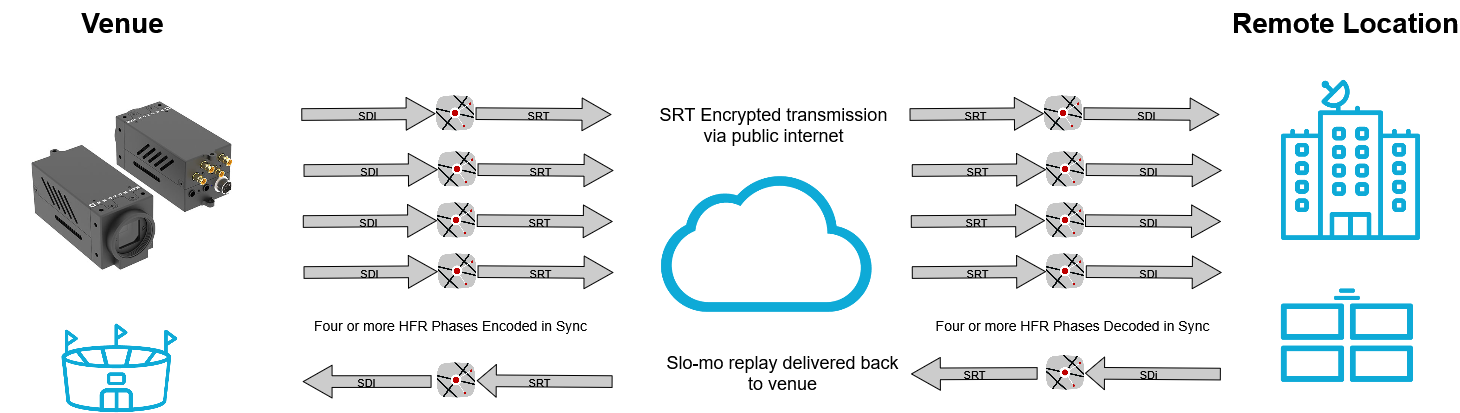
 Slow-motion replays have long been a staple in sports broadcasting, allowing fans to relive thrilling moments in exquisite detail. Traditionally, achieving these replays involves expensive specialised equipment and logistical challenges, as both the replay equipment and operators need to be on-site.
Remote slow-mo changes this. It allows for replay equipment and operators to remain in a central location and send slo-mo feeds back to venue. Sounds easy? Not quite. As the sports broadcasting industry reduces costs, many broadcasts operate from venues with public internet connectivity to transport video. Any packet loss on this link disrupts the slo-mo feed. Reliability matters when viewers want to see that key moment. This blog post will explain how our low-latency encoder and decoders have solved this problem and why it matters.
Why Remote Slow-Mo Changes Everything
By enabling both the equipment and operators to be in one centralised location, remote slow-mo streamlines operations and cuts costs. A single team can handle multiple events in a single day using just one piece of replay equipment, improving productivity and resource allocation while ensuring consistently high-quality outputs.
What It Takes
Two key enablers are essential for seamless remote slow-motion in live broadcasts. The obvious one is low latency, which allows a fast response time, regardless of the distance between the action and the operator. The other is synchronisation: frames from the different slo-mo phases must remain perfectly in sync throughout the process for the slow-motion playback to remain smooth.
How We Enhance Remote Slow-Mo
Our low-latency contribution encoders and decoders enable remote slow-mo over unmanaged networks. Feeds from a slow-motion camera (for example, the Proton camera, which offers high-frame-rate capabilities that are ideal for slow-motion capture) can be sent back from the stadium to a central location through an Internet connection.
Using our robust SDI card’s multisync capabilities, each slo-mo phase can be synchronised while maintaining very low latency, ensuring that no detail is missed and allowing operators to handle real-time replays without interruption.
In addition, our in-house SRT implementation plays a key role. We are able to control every millisecond of the packet recovery and output process, unlike when using third-party SRT libraries. In addition, we are able to send a duplicate stream on the same link to improve the latency/resilience tradeoff, as explained in a previous blog post.
Demonstration: London to Brussels Case Study
In a recent live demonstration, the Proton camera captured slow-motion feeds in London and transported them to Brussels. Using our low-latency encoders and decoders and SRT over the Internet, these feeds were then transported to an operator in Brussels. All the phases remained perfectly in sync, with a latency of only 350 milliseconds.
This London-to-Brussels use case exemplifies the potential of remote slow-mo technology, especially in large countries such as the US, where long distances are common.